


1. GALAN elektrodeketel;
2. Kogelkraan;
3. Circulatiepomp;
4. Filter;
5. Aftapklep;
6. Expansievat;
7. Automatisch apparaat;
8. Luchtinlaatkanaal;
9. Driewegklep;
10. Automatisch apparaat voor vloerverwarming;
11. Vloerverwarmingscircuit.
De aansluiting scheme van de GALAN elektrodeketel

De aansluiting scheme van de GALAN elektrodeketel om de radiator + de floor verwarming
De area van de warmte-insulated floor zou niet exceed 30% van all verwarmd oppervlak:
Het aansluitingsschema van de GALAN elektrodenketel met de stijgleiding
De aansluiting scheme van te GALAN elektrodeketel om de ascension pipe:
1. GALAN elektrodeketel;
2. Kogelkraan;
3. Circulatiepomp;
4. Filter;
5. Aftapventiel;
6. Expansievat;
7. Automatisch toestel;
8. Luchtinlaatkanaal.


Het aansluitingsschema van de GALAN elektrodenketel (principe)
1. GALAN elektrodeketel;
2. Ball faucet;
3. Circulating pomp ;
4. Filter;
5. Blow valve;
6. Expansion tank;
7. Automatisch equipment;
8. Air-inlet duct.
De principle aansluiting scheme van de GALAN elektrodeketel:
Parallel aansluiting scheme van de GALAN elektrodeketel:
Parallel aansluiting scheme van de GALAN elektrodeketel
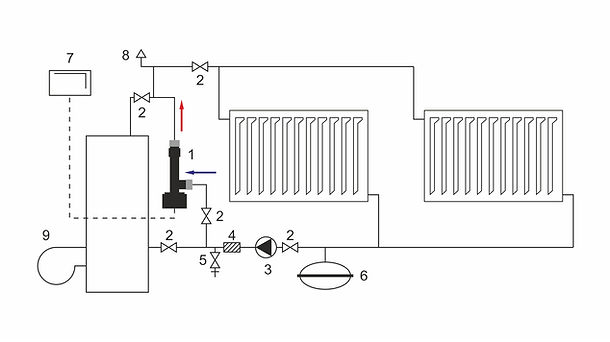
1. GALAN elektrodeketel;
2. Ball faucet;
3. Circulating pomp;
4. Filter;
5. Blow valve;
6. Expansion tank;
7. Automatisch equipment;
8. Air-inlet duct;
9. Verschillen warmte source (gas, oil of solid-fired ketel)
De series aansluiting scheme van de GALAN elektrodeketel

De series aansluiting scheme is good omdat het enables gebruik van van de solid-fired ketel (of gasketel) en elektrodeketel bij de same tijd (of door schakelt). Als je kan see aan de scheme: nadat verwarming, water comes van de elektrodeketel om return pipe (met de help van de elektrodeketel pomp). En alleen dan om de verwarmingssysteem directly. Whereby wij don’t install additional circulating pomp. De same happened met een expansion tank en veiligheidsgroep. There is also geen nodig om buy en install het omdat they zijn inside de elektrodeketel already. De blue pipe, which goes around de elektrodeketel is ontworpen om emergency shutdown van de elektrodeketel followed door demounting in order om continue systeem working met de gas (solid-fired) ketel.
De difference van de parallel aansluiting is dat het is mogelijk niet om schakelen over one van de ketels. Als far als met parallel aansluiting, unless de gasketel is turned over, hot water in elektrodeketel zal circulate via de small circle: van de gasketel om elektrisch one etc.
Operating scenario is de following :
Je instellen water temperatuur aan een gasketel - voor voorbeeld 50 graden. En aan een elektrodeketel - 55 graden en boven, but alleen bij nacht tijd. Als nacht falls, de elektrodeketel "understands" dat de temperatuur is less than het was required, dus het schakelt aan en verhoogt de warmtedrager temperatuur om 55 graden. Het maintains de temperatuur till de morning, en dan reduces temperatuur om 20 graden (voor voorbeeld). All dit tijd de gasketel was pumping water via itself door de recycling pomp, "thinking" dat het happens door zijn service, dat de water zal niet get cold en dat gas burners zijn niet switched aan. In de morning de gasketel sees dat de temperatuur fell om 50 graden als het was established en het gives de command om gas burners om schakelen aan. Dit scenario is ideal met de interval meter. In dit case economic effect zal zijn noticeable.
Solid-fired ketels zijn even more simple in gebruik. There is geen nodig in setting de temperatuur, omdat het is regulated while burning de wood of coal (except modern solid-fired ketels met regulation van de air feeding damper). Simply said, solid-fired ketel works while wood of coal is burning. When wood is burnt, dan een elektrodeketel switches aan.
There is one minus in dit scheme. Absolutely all double-circuit gasketels works aan de following principle: when je start de hot water in order om wash hands of dishes, de gasketel stops de de circulating pomp work. De flow channel in de verwarmingssysteem stop working. Een elektrodeketel continue de warmtedrager verwarming, but alleen van inside. Theoretically, de water termocontroller, installed in de elektrodeketel zal zijn activated. But het kan niet happen voor some technical reason. In any event dit variant is mogelijk. What zal happen dan? De pressure in de systeem zal jump en excessive water zal start flow uit van de relief valve van de gasketel. Anyway, nothing good.
Het is better niet om open hot water while een elektrodeketel is working. But het is de case van double-circle gasketels. Het zal niet happen met single-circuit en solid-fired ketels due om de absense van de second hot water circuit.
Voor starting-tot de elektrodeketel in de floor verwarming installatie het is necesssary om prepare water In de followin way:
Start tot de systeem en measure stroom bij de return temperatuur 40 C
Ketel Peak stroom bij 40 С
2 kW – 10 А
3 kW – 13 А
5 kW – 25 А
6 kW – 28 А
9 kW-220 V – 40 А
9 kW-380 V – 16 А
15 кW – 25 А
25 кW – 40 А
Als bij 40 graden return temperatuur de stroom does niet conform om de pointed in de table parameters,
proceed als follows:
1. Als de stroom is less - het is needed om toevoegen gradually salting liquid (het reduces elektrisch resistivity van de liquid). First stage - geen more than 1 teaspoon voor 100 litres van water. Als in 4 uur stroom increases slightly, Het is noodzakelijk om repeat de first stage.
2. Als de stroom is bigger - toevoegen distilled water (het increses elektrisch resistivity van de liquid). When water is prepared Het is noodzakelijk om reduce de water temperatuur aan de ketel outlet (sensor #2) om 40 graden.
CAUTION!!!
While gebruik van een elektrodeketels voor verwarming de floors elektrisch energy consumption increases meaningfully.
Aansluiting scheme van de GALAN elektrodeketel met de floor verwarming

1. GALAN elektrodeketel;
2. Kogelkraan;
3. Circulatiepomp;
4. Filter;
5. Aftapventiel;
6. Expansievat;
7. Automatisch toestel;
8. Luchtinlaatkanaal;
9. Bypassleiding;
10. Vloerverwarmingscircuit;
11. Mengmotorklep;
12. Kamerthermostaat.
Connection scheme of the GALAN elctrode boiler with the floor heating: